The Advisory Board
Healthcare Research Cycle 2016
Content Team
Project: Star Ratings of Long-Term Care Facilities
Setting the stage: My product partner at the Advisory Board gave me a call and asked if I could help her send an email to our members that included four PDF attachments and several external links.
The Centers for Medicare & Medicaid Services (CMS) had just released their final year rule. In it, they revamped their star ratings program, which rewards stars to long-term care facilities as an evaluation of their quality of care. Because potential residents and their families focus heavily on star ratings, hospital and health system administrators needed to understand how CMS’ changes would affect them. That’s why my product partner built a complicated list of resources to help.
The problem: I explained that sending an attachment-laden email to subscribers wasn’t a best practice for many reasons. Our target audience—healthcare administrators—was made up of busy people. Like most executives, they juggled different concerns and didn’t have the time to read through a list of studies and articles.
Equally as troubling, sending out my product partner’s hard work as PDFs meant that we would lose control over our content. Why would anyone pay to access a study that their colleague could forward them for free?
I focused on transforming my product partner’s pain point into a new solution through iterative change.
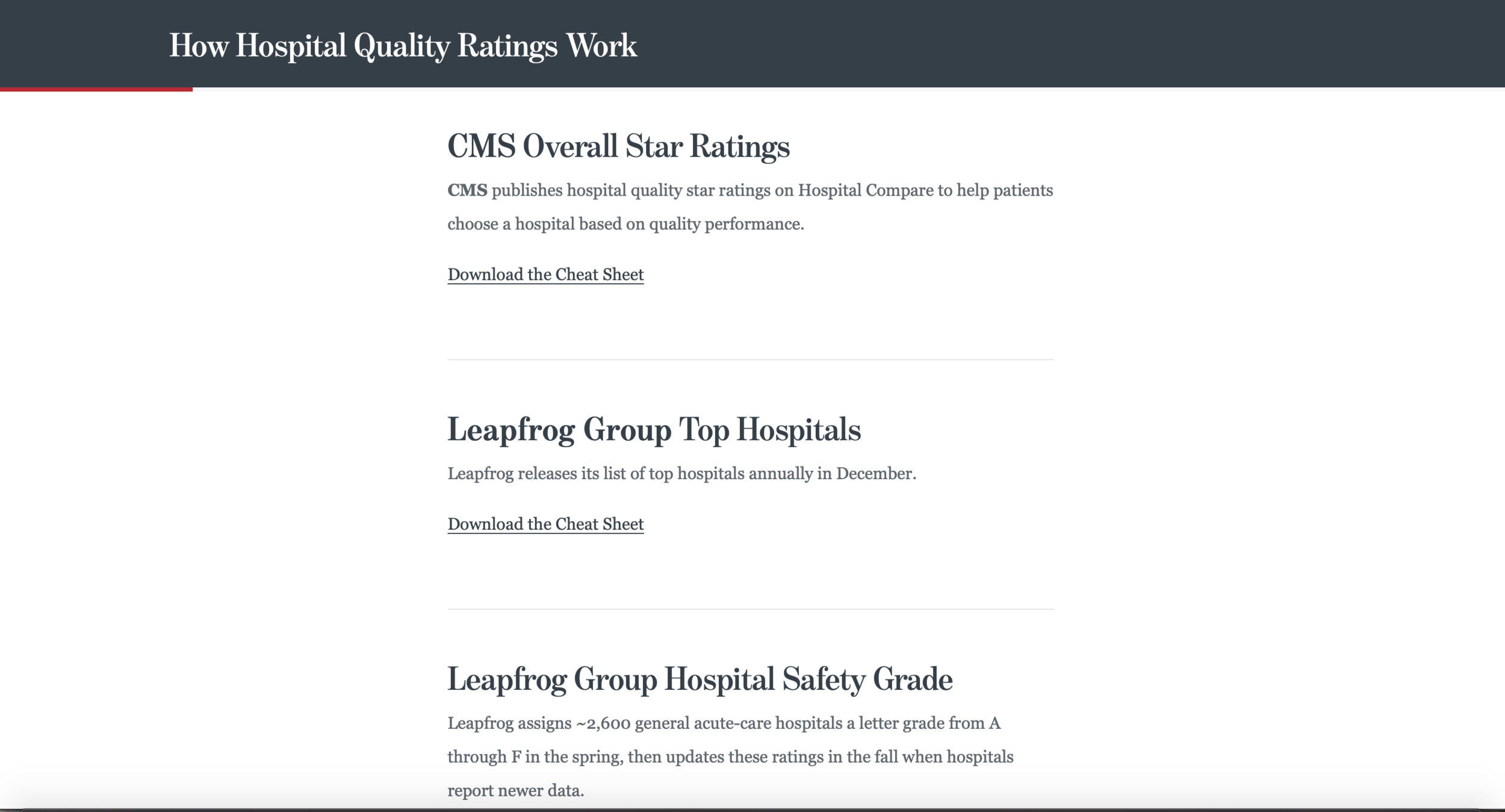
The project: What did our audience need? A quick, reliable synopsis of important changes to government ratings for their long-term health facilities.
We needed to create a deliverable that would provide this, so I pitched a series of cheat sheets to my product partners that would do just that.
I walked the team through my communication plan. I decided to collect all the cheat sheets on a single landing page, allowing me to include the link in a single call to action, easily track success metrics around user behavior, and keep our research in-house. We could update the cheat sheets as needed with each new annual CMS rule, creating a suite of evergreen high-demand resources.
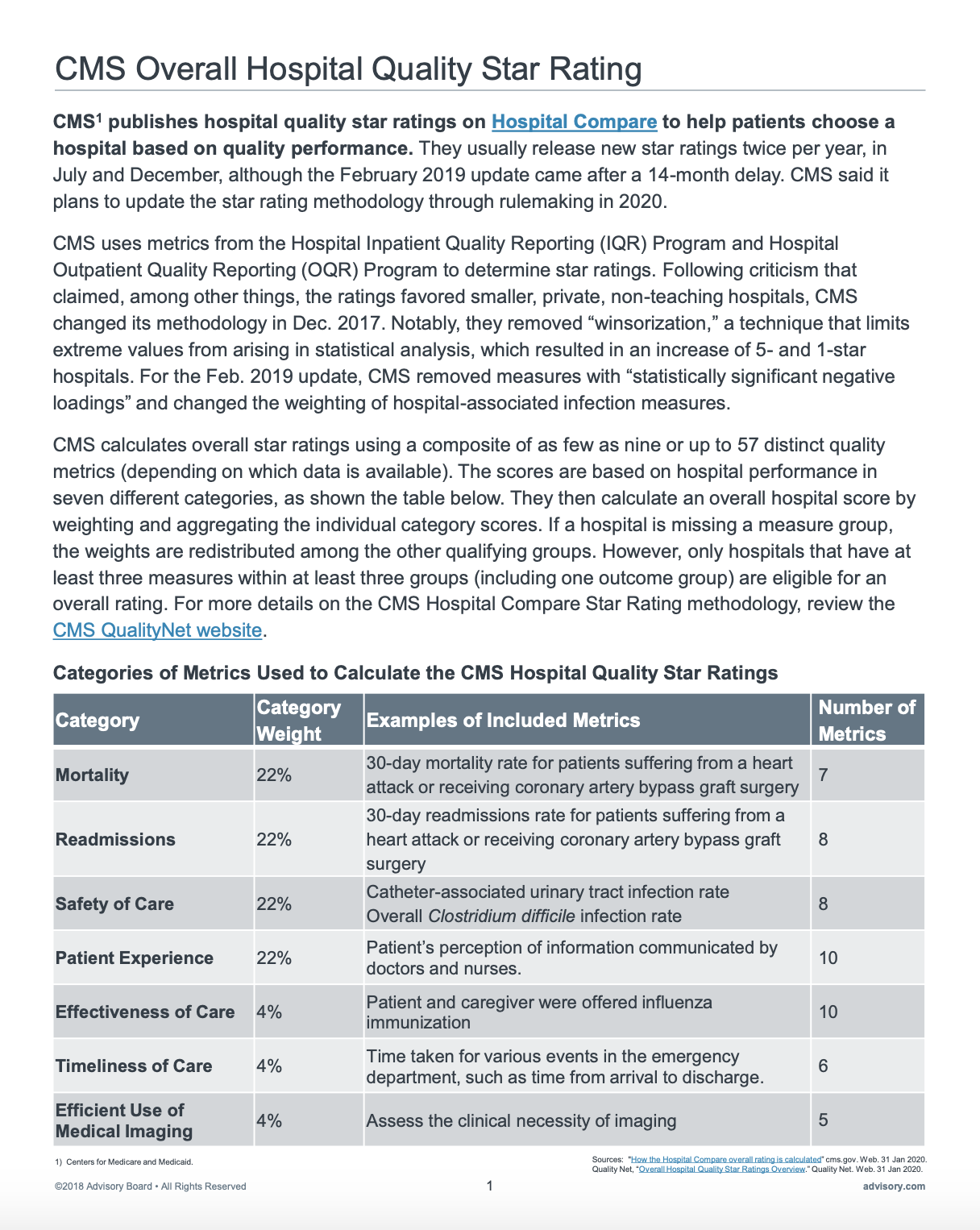
The results: My product partners designed cheat sheets that I edited and built into a webpage. It listed ratings questions in bold and linked to corresponding cheat sheets. I wanted members to be able to visit the page, quickly identify their specific concern, and find immediate answers. I also used content tags to make the cheat sheets easily searchable, both on our website and via external search engines.
I created an automized email campaign in Eloqua with the subject line, “Good news: We answered all your CMS star ratings questions in one place.” It was our product’s most successful email ever, with nearly a forty percent open-to-click rate.
I sent it to a list of 1,300 members, and the email racked up an impressive number of conversions: over 400 downloads, 200 webinars registrations, and 45 national meeting registrations, our biggest event where product partners presented annual research in-person. I won the Advisory Board’s quarterly research award for this project
In the time since, the Advisory Board has revamped their website. The cheat sheets have become so popular that they are now used for external marketing purposes.
The Advisory Board
Healthcare Research Cycle 2016
Content Team
Project: Cheat Sheets for Health Care Industry Partners
Setting the stage: Because our star ratings cheat sheets performed so well on our content metrics as tracked through the Web Analytics platform, I wanted to add the cheat-sheet-style deliverable format to our pattern library. My goal was to make page and resource creation more efficient.
The perfect place to try iterating our initial success came via the Health Care Industry Committee, our research product targeted at companies who sold goods, services, and technology to health systems.
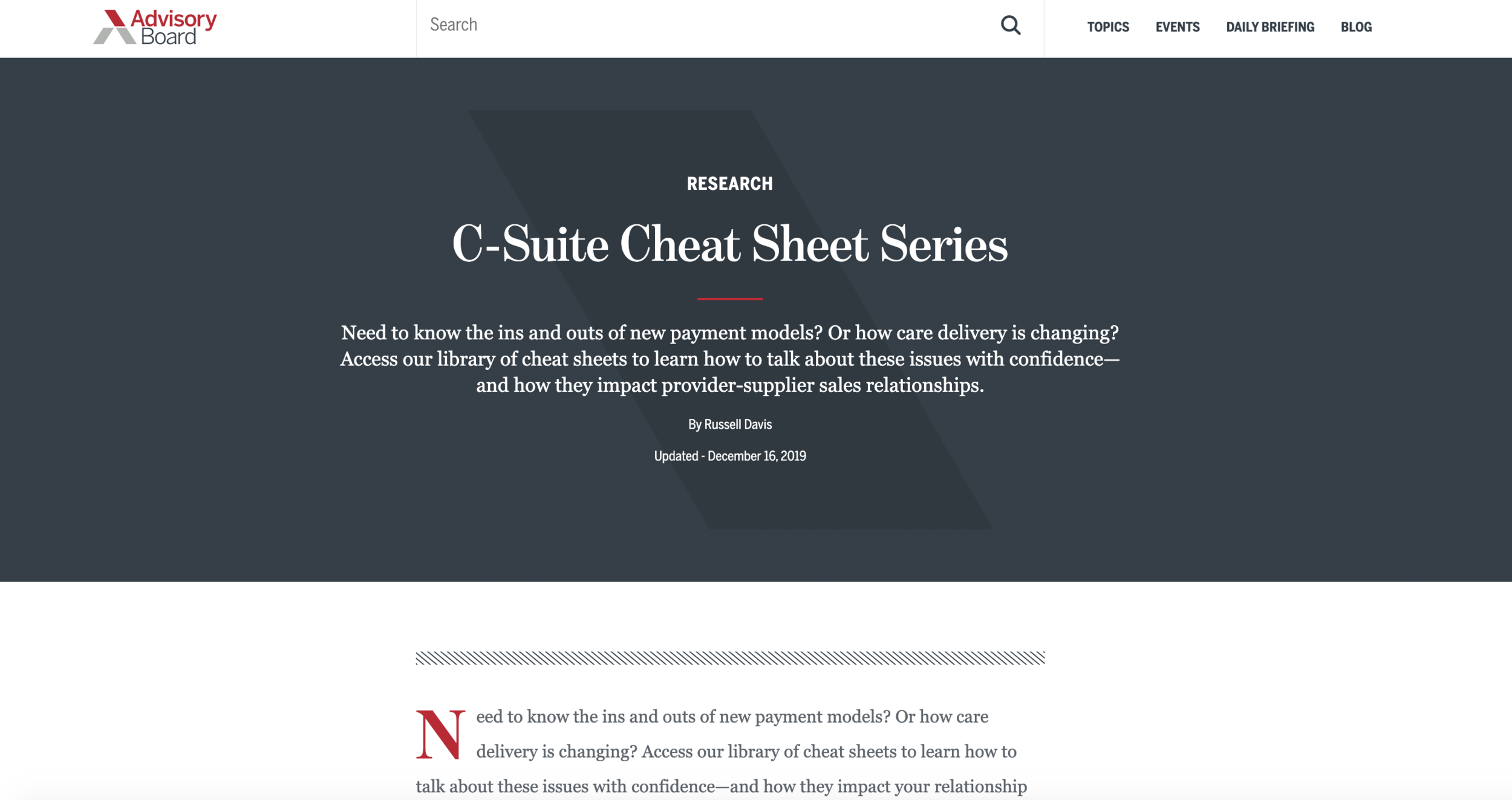
The problem: These members wanted a deeper understanding of the health care industry and its biggest trends in order to more effectively market their products to health care leaders.
The project: We created a series of cheat sheets for these members, using the same page layout I had built for our star ratings project. The cheat sheets explained the stresses on health systems to offer better telehealth services, the increasing challenge of health provider burnout, new payment models due to the Affordable Care Act, and more.
The results: I designed an email using Sharepoint and Eloqua. I sent it to our industry services subscription list, and once again, the emailed performed better than any previous one for this particular product. I also featured a single cheat sheet on the Health Care Industry Committee’s product blog, which saw a 200% day-to-day increase in likes and shares.
Because of the email and blog post, more than 100 people registered for webinars and over 30 institutions registered for national meeting slots in order to hear my product partners explain their research live and in-person.
Although the Advisory Board’s website has been completely redesigned and many resources removed, the cheat sheets remain as an evergreen popular deliverable that can be repackaged into different email campaigns and marketing plans.